
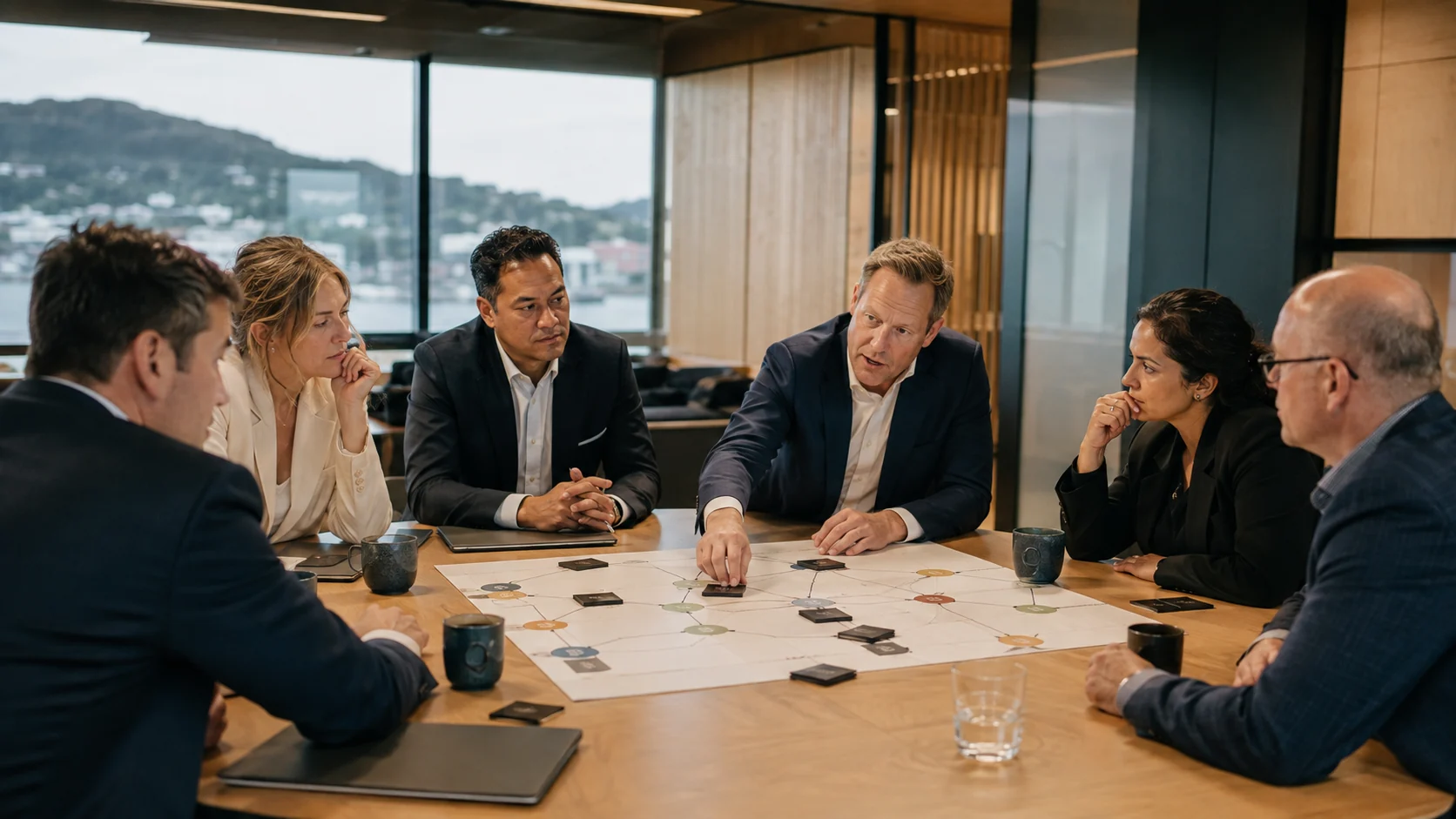
Executive-team performance is visible in the movement of enterprise value - not in the apparent quality of the meeting.
Take one strategic priority - growth in a chosen segment, a major cost reset, an integration or a digital shift - and follow it through the executive team. Not through the slide deck. Through the decisions, hand-offs and trade-offs that determine what the organisation actually does.
The strategy may begin clearly. Then commercial wants speed, operations wants stability, finance protects the near-term number, technology is carrying a dependency nobody surfaced, and people leaders see a capability constraint that has not yet entered the plan. Each position can be rational. The combined result can still be value lost between functions.
The wrong unit of analysis
Leadership-team work is often diagnosed through behaviours: trust, candour, communication and conflict. Those matter. But beginning there can produce a better conversation without producing better enterprise decisions. The more revealing question is whether the team can move a consequential priority across organisational boundaries without fragmenting it.
BCG frames this as the shift from individual "superheroes" to an enterprise-first leadership team.[1] The point is not that relationships are secondary. It is that relationships must serve work that only this team can do.
In senior roles across different markets, I have seen capable executives agree with a strategy in principle and still pull it apart in practice. The breakdown rarely announces itself as resistance. It appears as a reasonable functional exception, an unresolved dependency or one more decision sent back to the chief executive.
Follow the strategy across four interfaces
From ambition to explicit choice
Ask each executive to describe the priority without referring to the presentation. If the answers contain different customer, investment or timing assumptions, the problem is not communication lower in the organisation. The choice is not yet settled at the top.
From functional success to enterprise trade-off
The hardest decisions rarely optimise every function at once. A credible executive team must be able to move resources, stop locally attractive work and absorb an uneven burden when the enterprise case requires it. This is where nominal alignment is tested. Agreement with the strategy is inexpensive; accepting its consequences is not.
From decision to coordinated movement
A decision is not complete when the meeting ends. It is complete when dependencies are visible, authority is clear and the next layer of leaders can act without sending the issue back upstairs. Repeated escalation is often a sign that the executive team has left the interface unresolved.
From activity to evidence of value
Teams can be busy and still avoid the commercial question. What value should move? By when? Through which leading indicators? An MIT Sloan global study found that only 26 per cent of senior managers strongly agreed that their key performance indicators were aligned with strategic objectives.[3] The number is less important than the discipline it exposes: the team must connect its work to the result it exists to move.
Why conventional team-building rarely reaches the problem
An offsite can reset energy and create permission for a different conversation. It cannot, on its own, redesign the flow of decisions, resources and accountability. If the team returns to the same agenda, measures and incentives, the old system will usually win.
The better starting point is live work. Put the priority in the room. Surface where interpretations diverge, make the trade-offs explicit and test whether collective commitments survive contact with functional pressure. Team development becomes commercially useful when the team improves both how it works and what the enterprise is able to achieve.
A 90-day performance question
Choose one enterprise priority with real value at stake. Map the decisions it requires, the functions it crosses, the behaviours it exposes and the evidence that will show movement. Then use that priority as the workbench for the executive team over 90 days.
The team will learn more about itself from one real trade-off than from a long discussion about its preferred culture. It will see who brings an enterprise perspective, where candour stops, which issues are repeatedly escalated, how quickly decisions decay and whether collective commitments hold.
The goal is not harmony. It is a team able to convert strategy into coordinated performance - especially when the trade-offs are difficult and the organisation is watching.
Questions worth carrying into the room
- Which strategic priority most depends on cooperation across functions?
- Where does that priority currently slow down, change meaning or return for escalation?
- Which locally rational decision is weakening the enterprise result?
- What evidence would show that the executive team - not only each function - has improved performance?
Sources and further reading
- Boston Consulting Group (2024), "The Senior Leadership Team Can Make or Break CEO Success." https://www.bcg.com/publications/2024/senior-leadership-can-make-or-break-ceo-success
- McKinsey & Company (2025), "Demystifying top-team performance: What every CEO needs to know." https://www.mckinsey.com/capabilities/strategy-and-corporate-finance/our-insights/demystifying-top-team-performance-what-every-ceo-needs-to-know
- MIT Sloan School of Management (2018), "Only 26% of senior managers strongly agree their KPIs are aligned with strategic objectives." https://mitsloan.mit.edu/press/new-mit-sloan-management-review-study-finds-only-26-senior-managers-strongly-agree-their-key-performance-indicators-are-aligned-their-organizations-strategic-objectives
- Stanford Graduate School of Business (2010), "What Is the Best Path to Realizing Organizational Change?" https://www.gsb.stanford.edu/insights/what-best-path-realizing-organizational-change
- McKinsey & Company (2024), "All about teams: A new approach to organizational transformation." https://www.mckinsey.com/capabilities/people-and-organizational-performance/our-insights/all-about-teams-a-new-approach-to-organizational-transformation